
🌴 Coconut Promotion & High-Value Agriculture Schemes in India: Boosting Farmers’ Income and Sustainable Growth
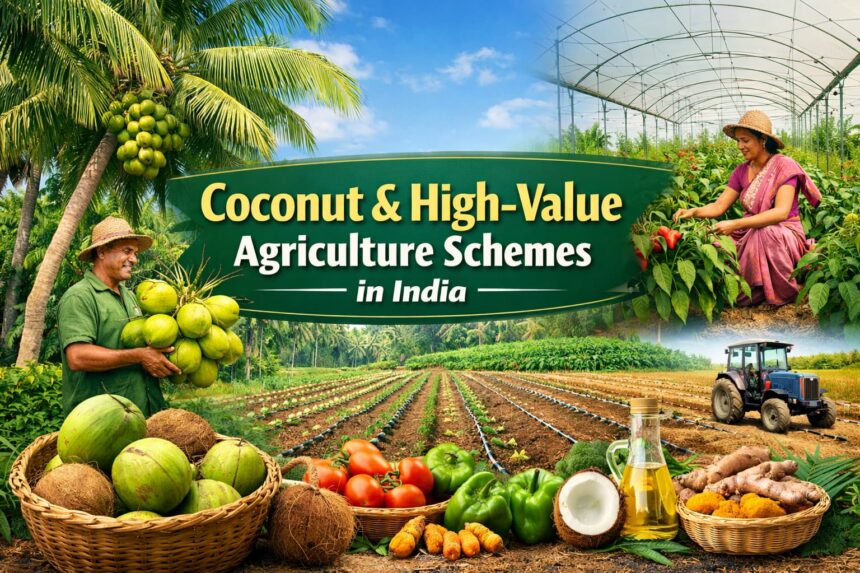
India is one of the world’s largest producers of coconut and high-value agricultural crops, providing livelihoods to millions of farmers. To strengthen this sector, the Government of India has introduced several Coconut Promotion and High-Value Agriculture (HVA) schemes aimed at improving productivity, increasing exports, and enhancing farmers’ income through diversification and modern farming techniques.
- 📌 Why Coconut & High-Value Agriculture Matter?
- 1️⃣ Coconut Development Board (CDB) Schemes
- Key Components
- 🌱 Area Expansion & Replanting
- 💧 Integrated Farming & Intercropping
- 🏭 Processing & Value Addition
- 🚜 Technology & Mechanization
- 💰 Subsidy Benefits
- 2️⃣ Mission for Integrated Development of Horticulture (MIDH)
- 3️⃣ National Horticulture Board (NHB) Schemes
- 4️⃣ Paramparagat Krishi Vikas Yojana (PKVY)
- 1️⃣ What is the Coconut Development Board (CDB) scheme?
- 2️⃣ How much subsidy is available for coconut and horticulture farming?
- 3️⃣ What are High-Value Agriculture (HVA) crops?
- 4️⃣ Who can apply for these agriculture schemes?
- 5️⃣ How can farmers apply for coconut or horticulture subsidies?
In this blog, we’ll explore the top government schemes, benefits, subsidies, and how farmers can apply.
📌 Why Coconut & High-Value Agriculture Matter?
Coconut and high-value crops such as spices, fruits, vegetables, floriculture, and medicinal plants offer:
✅ Higher profits per acre
✅ Better export opportunities
✅ Climate resilience
✅ Year-round income
✅ Value-addition potential (processing & branding)
These crops help farmers move beyond traditional farming and adopt commercial agriculture models.
🥥 Coconut Promotion Schemes in India
1️⃣ Coconut Development Board (CDB) Schemes
The Coconut Development Board (CDB) under the Ministry of Agriculture promotes coconut cultivation across major producing states like Kerala, Tamil Nadu, Karnataka, Andhra Pradesh, Odisha, and more.
Key Components
🌱 Area Expansion & Replanting
- Financial support for new plantations
- Replanting old/diseased palms
- Assistance for quality seedlings
💧 Integrated Farming & Intercropping
- Mixed cropping (banana, cocoa, spices)
- Better land utilization
- Higher returns
🏭 Processing & Value Addition
- Copra processing
- Virgin coconut oil units
- Coconut water packaging
- Coconut shell/handicrafts
🚜 Technology & Mechanization
- Coconut climbing machines
- Harvesting tools
- Drip irrigation
💰 Subsidy Benefits
- 40–60% subsidy on inputs and machinery
- Training and skill development programs
- Farmer Producer Organizations (FPOs) support
🌾 High-Value Agriculture (HVA) Schemes
High-Value Agriculture focuses on horticulture, floriculture, spices, medicinal plants, and exotic vegetables.
2️⃣ Mission for Integrated Development of Horticulture (MIDH)
MIDH is one of the biggest schemes supporting high-value crops.
Coverage Includes:
- Fruits
- Vegetables
- Flowers
- Spices
- Medicinal plants
- Mushroom cultivation
Benefits
✅ Nursery establishment
✅ Polyhouse/shade net house subsidy
✅ Drip irrigation support
✅ Cold storage & packhouses
✅ Organic farming assistance
Subsidy
- 35–55% for general farmers
- Up to 70% for SC/ST/women farmers
3️⃣ National Horticulture Board (NHB) Schemes
Ideal for commercial farmers and agri-entrepreneurs.
Support For:
- High-tech horticulture projects
- Post-harvest infrastructure
- Cold chain logistics
- Export-oriented farming
Financial Assistance
- Credit-linked back-ended subsidy
- 35–50% project cost support
4️⃣ Paramparagat Krishi Vikas Yojana (PKVY)
For organic high-value farming.
Benefits
- Organic certification
- Branding support
- Cluster-based farming
- Premium market prices
🚀 How Farmers Can Benefit
Farmers adopting coconut and HVA schemes can:
🌟 Increase income 2–3 times
🌟 Reduce production risks
🌟 Access modern technology
🌟 Get market linkages
🌟 Export produce
🌟 Create agri-business startups
📝 How to Apply for These Schemes?
Step-by-Step Process
- Visit State Agriculture/Horticulture Office
- Register on relevant portals:
- Coconut Development Board
- MIDH/NHB portals
- Submit:
- Aadhaar
- Land documents
- Bank details
- Project proposal (for large units)
- Field inspection & approval
- Subsidy disbursement
📊 Why Invest in Coconut & High-Value Crops Now?
With rising demand for:
- Coconut oil
- Healthy beverages
- Organic fruits & vegetables
- Exotic crops
These sectors are becoming high-profit agriculture businesses, not just farming.
Government incentives make this the best time to diversify.
✅ Final Thoughts
Coconut and High-Value Agriculture schemes are game-changers for Indian farmers. With proper planning, government support, and modern techniques, farmers can shift from low-income crops to high-profit sustainable agriculture.
If you’re a farmer or agri-entrepreneur, now is the right time to explore these schemes and maximize your income.
❓ Top 5 FAQs – Coconut Promotion & High-Value Agriculture Schemes
1️⃣ What is the Coconut Development Board (CDB) scheme?
The Coconut Development Board (CDB) scheme supports farmers with financial assistance for coconut plantation, replanting old trees, irrigation, machinery, processing units, and value addition to increase income and productivity.
2️⃣ How much subsidy is available for coconut and horticulture farming?
Farmers can get 40%–60% subsidy for coconut farming and 35%–70% subsidy under horticulture schemes like MIDH for polyhouses, irrigation systems, nurseries, and infrastructure. The amount varies by state and category.
3️⃣ What are High-Value Agriculture (HVA) crops?
High-Value Agriculture crops include fruits, vegetables, flowers, spices, medicinal plants, and exotic crops. These crops provide higher profits and better market demand compared to traditional crops like wheat and rice.
4️⃣ Who can apply for these agriculture schemes?
Small and marginal farmers, FPOs, SHGs, cooperatives, and agri-entrepreneurs with valid land records and Aadhaar-linked bank accounts are eligible to apply for most coconut and horticulture schemes.
5️⃣ How can farmers apply for coconut or horticulture subsidies?
Farmers can apply by visiting their local Agriculture/Horticulture Department or registering on CDB, MIDH, or NHB portals, submitting required documents, and completing field verification before subsidy approval.