
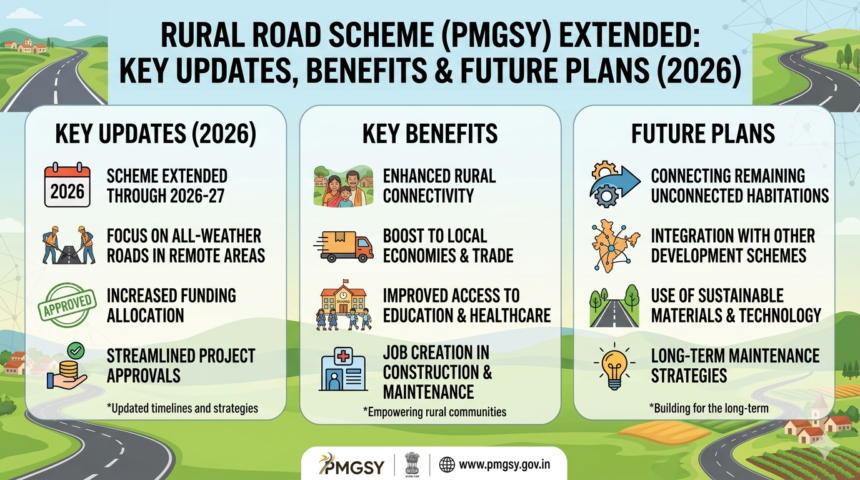
Rural Road Scheme (PMGSY) Extended: Key Updates, Benefits & Future Plans (2026)
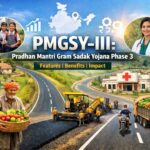
India’s rural infrastructure has received a major boost with the extension of the Pradhan Mantri Gram Sadak Yojana (PMGSY). The government has not only extended the existing phase but also introduced a new one to ensure last-mile connectivity across the country.
- What is PMGSY?
- Latest Update: PMGSY Extended Till 2028
- Introduction of PMGSY-IV (2024–2029)
- Evolution of PMGSY: All Phases Explained
- Key Benefits of PMGSY Extension
- 1. Improved Rural Connectivity
- 2. Economic Growth
- 3. Better Education & Healthcare
- 4. Boost to Agriculture
- 5. Social Inclusion
- Impact So Far
- Challenges Ahead
- Future Outlook
- Conclusion
- FAQs
In this blog, we’ll cover everything you need to know about the PMGSY extension, new phase (PMGSY-IV), benefits, and its impact on rural development.
What is PMGSY?
The Pradhan Mantri Gram Sadak Yojana (PMGSY) is a flagship rural development scheme launched in 2000 by the Government of India.
Objective:
- Provide all-weather road connectivity to unconnected rural habitations
- Improve access to education, healthcare, and markets
- Boost economic growth in rural areas
Latest Update: PMGSY Extended Till 2028
The government has extended PMGSY Phase III till March 2028.
Why the Extension?
- To complete pending road projects
- To upgrade existing rural road networks
- To improve connectivity to:
- Gramin Agricultural Markets (GrAMs)
- Schools and colleges
- Hospitals and health centres
This extension ensures that ongoing infrastructure projects are completed efficiently.
Introduction of PMGSY-IV (2024–2029)
Alongside the extension, the government has launched PMGSY Phase IV, focusing on connecting remaining rural areas.
Key Highlights:
- 25,000 unconnected habitations to be linked
- 62,500 km of new roads planned
- Budget allocation: ₹70,000+ crore
- Implementation period: 2024 to 2029
This phase targets remote and difficult regions, ensuring inclusive development.
Evolution of PMGSY: All Phases Explained
1. PMGSY Phase I
- Focus: Connecting unconnected villages
- Massive expansion of rural road network
2. PMGSY Phase II
- Focus: Upgrading existing roads
- Improved road quality and durability
3. PMGSY Phase III (Extended)
- Focus: Route consolidation
- Better connectivity to economic and social hubs
4. PMGSY Phase IV (New)
- Focus: Remaining habitations
- Strengthening last-mile connectivity
Key Benefits of PMGSY Extension
1. Improved Rural Connectivity
Villages get year-round access to essential services.
2. Economic Growth
- Easier transportation of goods
- Better access to markets
- Increased rural employment
3. Better Education & Healthcare
- Students reach schools faster
- Patients access hospitals in emergencies
4. Boost to Agriculture
Farmers can transport produce efficiently, reducing losses.
5. Social Inclusion
Bridges the urban-rural divide and improves quality of life.
Impact So Far
- Over 8 lakh km of roads sanctioned
- Around 95% projects completed
- Millions of rural residents connected
PMGSY has become one of the most successful rural infrastructure programs in India.
Challenges Ahead
Despite progress, some challenges remain:
- Difficult terrain in remote regions
- Maintenance of rural roads
- Climate and weather-related damage
- Funding and execution delays
The extension aims to address these issues.
Future Outlook
With PMGSY extended till 2028 and Phase IV launched, India is moving closer to:
- 100% rural road connectivity
- Stronger rural economies
- Improved living standards
This initiative will play a crucial role in achieving inclusive and sustainable development.
Conclusion
The extension of the Rural Road Scheme (PMGSY) marks a significant step toward transforming rural India. With continued investment and planning, the scheme is set to connect every village, empower communities, and drive economic growth.
FAQs
1. What is PMGSY?
A government scheme to provide all-weather road connectivity to rural areas.
2. Till when is PMGSY extended?
PMGSY Phase III is extended till March 2028.
3. What is PMGSY-IV?
A new phase (2024–2029) aimed at connecting 25,000 unconnected habitations.
4. How many roads will be built under PMGSY-IV?
Around 62,500 km of roads.