
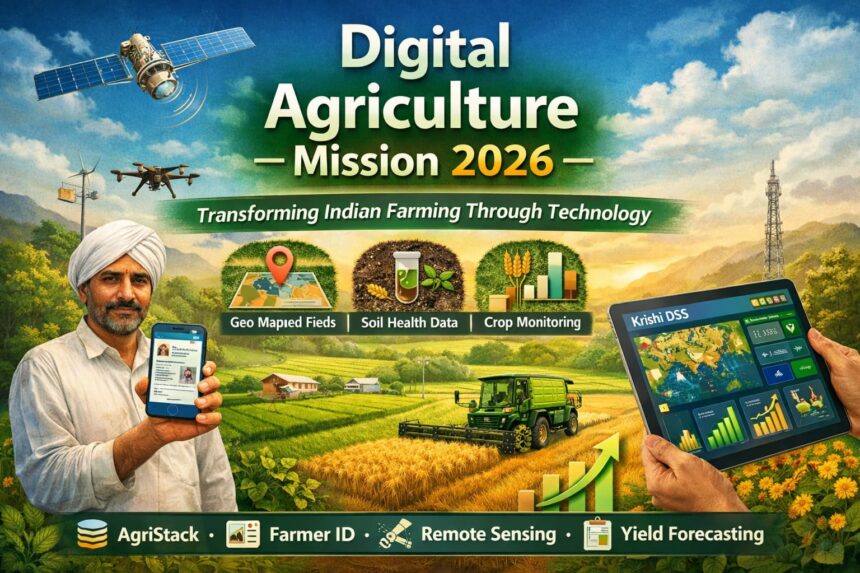
🌾 Digital Agriculture Mission 2026: Transforming Indian Farming Through Technology
India’s agriculture sector is undergoing a historic transformation with the launch of the Digital Agriculture Mission (DAM). Introduced by the Government of India, this mission aims to modernize farming using digital technology, data analytics, satellite imagery, and artificial intelligence.
- 📌 What is the Digital Agriculture Mission?
- 🎯 Objectives of Digital Agriculture Mission 2026
- 🧱 Key Components of Digital Agriculture Mission
- 1️⃣ AgriStack (Digital Agriculture Stack)
- 2️⃣ Farmer ID (Digital Identity)
- 3️⃣ Krishi Decision Support System (DSS)
- 4️⃣ Digital Crop Survey & Yield Estimation
- 5️⃣ Soil Health Mapping
- 💰 Budget & Funding
- 📈 Benefits of Digital Agriculture Mission
- 🚜 Role of Technology in Digital Agriculture
- ⚠️ Challenges of Digital Agriculture Mission
- 🔮 Future Scope of Digital Agriculture Mission
- 📝 Conclusion
With agriculture supporting over 50% of India’s population, the Digital Agriculture Mission 2026 is designed to make farming smarter, more transparent, climate-resilient, and income-oriented.
📌 What is the Digital Agriculture Mission?
The Digital Agriculture Mission (DAM) is a flagship initiative of the Government of India to build a digital ecosystem for agriculture by integrating:
- Farmer databases
- Land records
- Crop information
- Weather and soil data
- Technology platforms
It aims to provide end-to-end digital solutions for farmers and policymakers through AgriStack, similar to how Aadhaar transformed identity systems.
🎯 Objectives of Digital Agriculture Mission 2026
The main objectives of the mission are:
✅ Digitization of Indian agriculture
✅ Creation of a Farmer Digital ID
✅ Accurate crop and land data collection
✅ Better implementation of government schemes
✅ Improved crop planning and productivity
✅ Reduction in input cost and crop losses
✅ Data-driven policymaking
✅ Promotion of smart and sustainable farming
🧱 Key Components of Digital Agriculture Mission
1️⃣ AgriStack (Digital Agriculture Stack)
AgriStack is the core digital backbone of the mission.
It includes:
- Farmer Registry – Digital identity of farmers
- Geo-referenced land records
- Crop sown registry
- Linking of schemes, subsidies, and insurance
🎯 Target: Creating digital profiles for 11 crore farmers by 2026–27
2️⃣ Farmer ID (Digital Identity)
Each farmer will receive a unique Farmer ID linked to:
- Land ownership
- Crops grown
- Soil data
- Government benefits
This helps in:
- Direct benefit transfer (DBT)
- Crop insurance claims
- Loan approvals
- Targeted subsidy delivery
3️⃣ Krishi Decision Support System (DSS)
This system uses:
- Satellite data
- Weather forecasting
- AI and GIS mapping
To provide:
- Crop advisories
- Drought & flood alerts
- Yield prediction
- Pest & disease monitoring
4️⃣ Digital Crop Survey & Yield Estimation
The Digital General Crop Estimation Survey (DGCES) helps in:
✔ Accurate crop area estimation
✔ Faster crop insurance settlement
✔ Better MSP planning
✔ Improved food security monitoring
5️⃣ Soil Health Mapping
Under this mission:
- Digital soil maps are created
- Nutrient status is analyzed
- Fertilizer usage is optimized
- Soil degradation is monitored
This promotes sustainable farming and reduces environmental damage.
💰 Budget & Funding
- Initial allocation: ₹2,800+ crore
- Funded by:
- Central Government
- State Governments
- Technology partners
- Budget expected to increase post-2026 with expansion of AgriStack
📈 Benefits of Digital Agriculture Mission
🌱 For Farmers
✔ Easy access to government schemes
✔ Reduced paperwork
✔ Accurate weather and crop advisory
✔ Faster crop insurance claims
✔ Better market linkage
🏛️ For Government
✔ Transparent data collection
✔ Improved policy planning
✔ Reduced leakages
✔ Efficient subsidy distribution
🌍 For Environment
✔ Optimized fertilizer usage
✔ Climate-resilient farming
✔ Water conservation
✔ Sustainable agriculture practices
🚜 Role of Technology in Digital Agriculture
The mission uses:
- Artificial Intelligence (AI)
- Satellite Remote Sensing
- GIS Mapping
- IoT Sensors
- Big Data Analytics
- Mobile Apps & Cloud Platforms
These technologies help in real-time decision-making and precision farming.
⚠️ Challenges of Digital Agriculture Mission
Despite its benefits, the mission faces challenges:
❌ Digital illiteracy among farmers
❌ Internet connectivity in rural areas
❌ Data privacy and security concerns
❌ Inter-state data integration issues
❌ Need for farmer awareness programs
🔮 Future Scope of Digital Agriculture Mission
By 2030, the mission aims to:
✅ Cover all farmers under AgriStack
✅ Integrate AI-based advisory services
✅ Enable smart irrigation systems
✅ Support climate-resilient agriculture
✅ Make India a global leader in digital farming
📝 Conclusion
The Digital Agriculture Mission 2026 is a landmark reform that has the potential to revolutionize Indian agriculture. By combining technology with traditional farming, it aims to make agriculture:
🌾 More productive
📊 Data-driven
🌍 Environment-friendly
💰 Profitable for farmers
If implemented effectively, this mission will play a crucial role in achieving Farmer Welfare, Food Security, and Digital India goals.
- Digital Agriculture Mission 2026
- AgriStack India
- Digital Farming India
- Farmer ID India
- Agricultural Technology in India
- Government Agriculture Scheme 2026
- Smart Farming India