
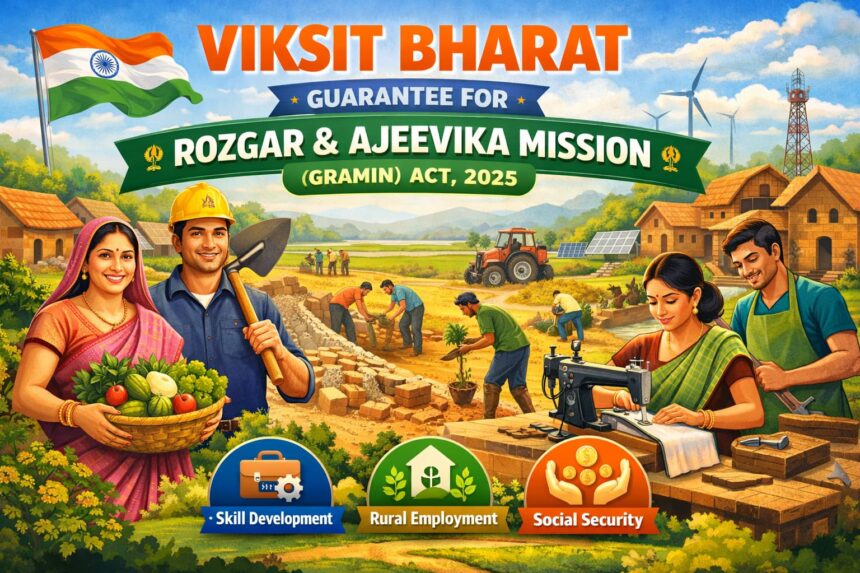
Viksit Bharat – Guarantee for Rozgar and Ajeevika Mission (Gramin) Act, 2025: Transforming Rural Employment in India
India has taken a giant step towards rural development and employment generation with the introduction of the Viksit Bharat – Guarantee for Rozgar and Ajeevika Mission (Gramin) Act, 2025. This landmark legislation aims to provide guaranteed employment and sustainable livelihood opportunities for rural populations, ensuring economic security and promoting inclusive growth.
What is the Viksit Bharat Rozgar and Ajeevika Mission (Gramin) Act, 2025?
The Viksit Bharat Act, 2025 is a progressive policy designed to:
- Guarantee employment to rural households for a fixed number of days annually.
- Promote self-reliance through skill development and rural entrepreneurship.
- Ensure social security and financial inclusion for the rural workforce.
It builds on the vision of a developed India (Viksit Bharat) by integrating rural employment schemes with modern economic strategies, bridging the urban-rural development gap.
Key Objectives of the Act
- Employment Guarantee:
The Act ensures that rural households are provided with meaningful employment opportunities, reducing migration to urban areas in search of jobs. - Skill Development and Training:
Focus on livelihood enhancement programs and skill-building workshops for rural youth, women, and marginalized communities. - Sustainable Livelihoods:
Encourages rural entrepreneurship, small-scale industries, and agriculture-linked employment to create self-sustaining villages. - Social Security Measures:
Rural workers gain access to healthcare, pension schemes, and insurance, ensuring comprehensive welfare alongside employment.
How the Act Will Impact Rural India
The Viksit Bharat Act is expected to transform the rural economy by:
- Reducing unemployment and underemployment in villages.
- Empowering women and youth through targeted employment and training programs.
- Encouraging eco-friendly and sustainable livelihood projects.
- Strengthening rural infrastructure, such as roads, water conservation, and digital connectivity.
Implementation Strategy
The Government of India will implement the Act through:
- State-level Employment Missions for localized job allocation.
- Skill Development Centers in rural areas to train the workforce.
- Digital monitoring systems to ensure transparency and timely payment of wages.
Benefits for Rural Citizens
- Guaranteed work for rural households, ensuring income stability.
- Access to training programs and skill certification.
- Opportunities to participate in government-backed livelihood projects.
- Financial inclusion through direct wage transfers and subsidies.
Conclusion
The Viksit Bharat – Guarantee for Rozgar and Ajeevika Mission (Gramin) Act, 2025 is more than just an employment program—it is a roadmap for holistic rural development. By combining job security with skill development and social welfare, the Act is set to empower millions of rural citizens and bring India closer to the vision of a truly developed nation.
The Act reflects India’s commitment to inclusive growth, ensuring that no village or household is left behind in the journey toward prosperity.
Here’s a Top 5 FAQ section for the Viksit Bharat – Guarantee for Rozgar and Ajeevika Mission (Gramin) Act, 2025, optimized for SEO and user clarity:
Top 5 FAQs About Viksit Bharat Rozgar and Ajeevika Mission (Gramin) Act, 2025
1. What is the Viksit Bharat Rozgar and Ajeevika Mission (Gramin) Act, 2025?
The Act is a government initiative aimed at guaranteeing employment and promoting sustainable livelihoods for rural households in India. It focuses on job creation, skill development, and social security, ensuring rural citizens can earn a stable income while contributing to village development.
2. Who is eligible for employment under this Act?
Eligibility is primarily for rural households, with special focus on women, youth, and marginalized communities. The government ensures that each household is provided with work for a minimum number of days annually, helping reduce migration to cities.
3. What types of work are provided under this Act?
The employment opportunities include:
- Infrastructure development projects (roads, water conservation, sanitation)
- Agricultural and allied activities
- Rural entrepreneurship and small-scale industries
- Skill-building and community development projects
4. How will the Act benefit rural citizens?
The benefits include:
- Guaranteed employment and income stability
- Access to skill development and training programs
- Opportunities to participate in government-backed livelihood initiatives
- Financial inclusion through direct wage transfers and insurance schemes
5. How is the Act implemented and monitored?
The Act is implemented through state-level employment missions and monitored using digital platforms to ensure transparency, proper allocation of work, and timely payment of wages. Skill development centers in rural areas provide training and certification to beneficiaries.