
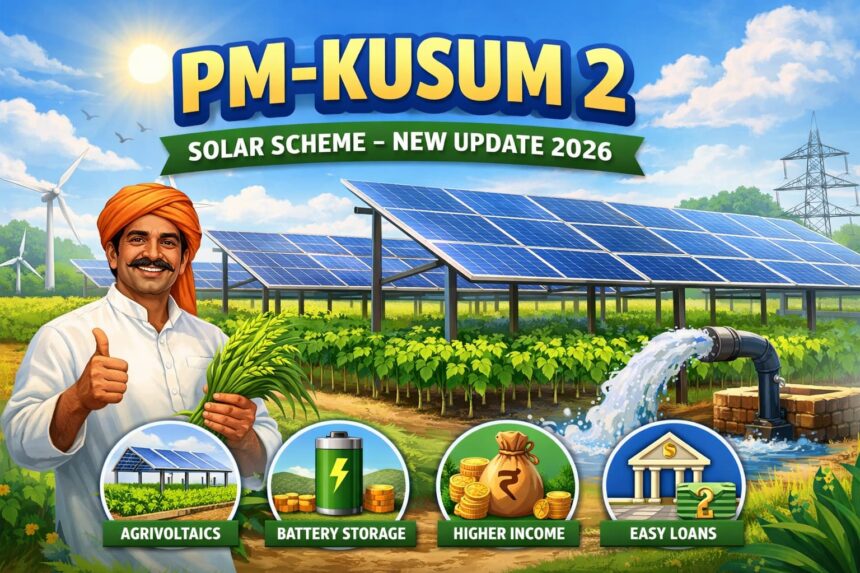
PM-KUSUM 2 (Solar Scheme – NEW UPDATE 2026)
Introduction
India is rapidly moving towards clean and renewable energy, and the agricultural sector is at the center of this transformation. The PM-KUSUM Scheme (Pradhan Mantri Kisan Urja Suraksha evam Utthaan Mahabhiyan) has already helped lakhs of farmers adopt solar energy.
- Key Highlights (New Updates)
- 1. 🌱 10 GW Agrivoltaics Component
- 2. 💻 Unified National Portal
- 3. 🔋 Battery Storage Integration
- 4. 💰 Improved Tariffs & Income
- 5. 🏦 Better Financing Support
- 6. 📅 Extended Deadlines
- 7. 🛠️ Stronger Accountability
- Component A – Solar Power Plants
- Component B – Standalone Solar Pumps
- Component C – Solarisation of Existing Pumps
- 🌾 For Farmers
- ⚡ For Government
- 🌍 For Environment
Now, the government is preparing to launch PM-KUSUM 2.0 (New Updated Version) with improved features, higher targets, and better financial support to make solar adoption easier and more profitable for farmers.
What is PM-KUSUM Scheme?
Launched in 2019, PM-KUSUM aims to:
- Provide energy security to farmers
- Promote solar-powered irrigation
- Reduce dependency on diesel and grid electricity
- Enable farmers to earn extra income by selling surplus power
The scheme targets installation of solar pumps and grid-connected solar plants across rural India.
PM-KUSUM 2.0 – What’s New?
The upgraded PM-KUSUM 2 (2026 update) focuses on solving the limitations of Phase 1 and scaling solar adoption.
Key Highlights (New Updates)
1. 🌱 10 GW Agrivoltaics Component
- Farmers can grow crops and generate solar power on the same land
- Solar panels are installed above fields (dual land use)
- Helps solve land availability issues
2. 💻 Unified National Portal
- Single platform for application & tracking
- Removes confusion of state-wise systems
- Improves transparency and faster approvals
3. 🔋 Battery Storage Integration
- Stores excess solar energy
- Provides power even during night or cloudy weather
- Improves reliability of solar irrigation
4. 💰 Improved Tariffs & Income
- Proposed increase in solar tariffs (~₹3.25 → ₹3.50/unit)
- Farmers can earn more by selling electricity
5. 🏦 Better Financing Support
- Link with Agriculture Infrastructure Fund (AIF)
- Easier loans with lower interest rates
- Reduced financial burden on farmers
6. 📅 Extended Deadlines
- Government extended timelines for projects till September 2026
- Ensures smooth transition to new phase
7. 🛠️ Stronger Accountability
- Mandatory bank guarantees for contractors
- Ensures quality installation and performance
Components of PM-KUSUM 2.0
The scheme continues with three major components:
Component A – Solar Power Plants
- Small solar plants (up to 2 MW)
- Installed on barren/fallow land
- Farmers earn by selling electricity
Component B – Standalone Solar Pumps
- Off-grid solar pumps
- Replaces diesel pumps
- Ideal for remote areas
Component C – Solarisation of Existing Pumps
- Convert existing electric pumps to solar
- Includes feeder-level solarisation for large-scale impact
Subsidy Structure (Financial Model)
PM-KUSUM 2.0 follows a 30-30-40 model:
- 30% Central Government subsidy
- 30% State Government subsidy
- 40% Farmer contribution (loan/self)
👉 In some cases, farmers may get up to 60–90% total support depending on state policies.
Benefits of PM-KUSUM 2.0
🌾 For Farmers
- Free or low-cost irrigation
- Extra income from solar power sale
- Reduced diesel expenses
⚡ For Government
- Reduced electricity subsidy burden
- Better rural power supply
🌍 For Environment
- Lower carbon emissions
- Clean and sustainable farming
Challenges in PM-KUSUM 1.0 (and Fixes in 2.0)
| Challenge | Solution in PM-KUSUM 2.0 |
|---|---|
| Loan difficulties | Easier financing schemes |
| Payment delays | Improved DISCOM payment systems |
| Land issues | Agrivoltaics (dual land use) |
| Maintenance gaps | Better service network |
How to Apply for PM-KUSUM 2.0
Step-by-Step Process:
- Visit official MNRE / state portal
- Register with Aadhaar & land details
- Select component (A, B, or C)
- Submit required documents
- Get approval & subsidy sanction
- Installation by authorised vendor
Who is Eligible?
- Individual farmers
- Farmer groups / cooperatives
- Panchayats
- Landowners with agricultural land
Future of PM-KUSUM 2.0
PM-KUSUM 2.0 is expected to:
- Add massive solar capacity in agriculture
- Increase farmer income significantly
- Promote energy independence in rural India
- Support India’s renewable energy goals
Conclusion
The PM-KUSUM 2 (Solar Scheme 2026 Update) is a major step toward combining agriculture with renewable energy. With features like agrivoltaics, better subsidies, improved financing, and battery integration, the scheme is more farmer-friendly than ever.
👉 For farmers, this is not just a subsidy scheme—it’s an opportunity to reduce costs, earn income, and become energy independent.