
Fertilizer Subsidy Scheme (NBS – Kharif 2026)
Introduction
Agriculture remains the backbone of India’s economy, and ensuring affordable access to fertilizers is critical for sustaining crop productivity. To support farmers during the crucial sowing season, the Government of India has approved the Nutrient-Based Subsidy (NBS) Scheme for Kharif 2026. This policy plays a vital role in stabilizing fertilizer prices and ensuring timely availability.
In this blog, we will explore the NBS scheme for Kharif 2026 in detail, including its objectives, features, working mechanism, benefits, and significance.
What is the NBS Scheme?
The Nutrient-Based Subsidy (NBS) Scheme is a government initiative introduced in 2010. Under this scheme, the government provides subsidies to fertilizer manufacturers and importers based on the nutrient content of fertilizers.
Unlike earlier systems, where subsidies were product-based, the NBS system focuses on nutrients such as:
- Nitrogen (N)
- Phosphorus (P)
- Potassium (K)
- Sulphur (S)
This encourages balanced fertilization and efficient use of soil nutrients.
Key Highlights of NBS – Kharif 2026
- Approval: Union Cabinet (April 2026)
- Validity Period: 1 April 2026 to 30 September 2026
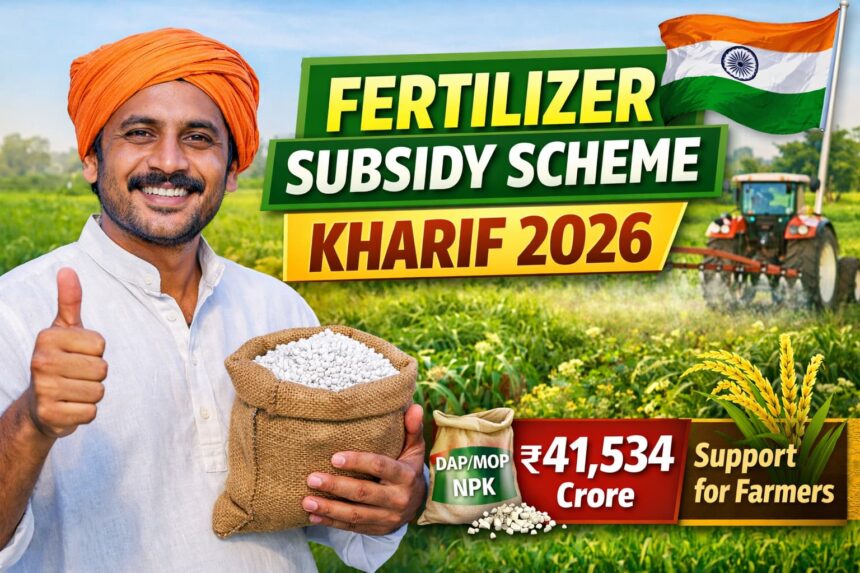
- Total Subsidy Outlay: Approximately ₹41,533 crore
- Coverage: 28 grades of Phosphatic and Potassic (P&K) fertilizers
- Target Group: Farmers across India
The scheme ensures that fertilizers remain affordable despite fluctuations in global prices of raw materials.
Objectives of the Scheme
The NBS Scheme for Kharif 2026 aims to:
- Ensure availability of fertilizers at reasonable prices
- Protect farmers from rising global fertilizer costs
- Promote balanced use of nutrients in agriculture
- Maintain soil health and improve crop productivity
- Support food security and agricultural growth
How the NBS Scheme Works
The functioning of the NBS scheme is straightforward:
- The government fixes a per kg subsidy rate for each nutrient (N, P, K, S).
- Fertilizer companies receive subsidies based on the nutrient composition of their products.
- Companies sell fertilizers to farmers at subsidized retail prices.
Important Note:
The subsidy is not directly transferred to farmers. Instead, it is routed through manufacturers to reduce the market price of fertilizers.
Fertilizers Covered Under the Scheme
The NBS scheme covers Phosphatic and Potassic (P&K) fertilizers, including:
- Di-Ammonium Phosphate (DAP)
- Muriate of Potash (MOP)
- Complex fertilizers like NPK and NPKS
These fertilizers are essential for improving soil fertility and ensuring better crop yields.
Special Focus for Kharif 2026
The Kharif 2026 version of the scheme includes several important considerations:
1. Price Stability
The government has taken steps to ensure that the retail price of key fertilizers like DAP remains stable despite volatility in global markets.
2. Increased Budget Allocation
The subsidy outlay has increased compared to previous years, reflecting the government’s commitment to supporting farmers.
3. Global Market Adjustment
Subsidy rates are aligned with international prices of raw materials such as ammonia, sulphur, and phosphoric acid.
4. Timely Availability
Efforts are made to ensure fertilizers are available during peak sowing months without shortages.
Benefits of the NBS Scheme
For Farmers
- Reduced cost of fertilizers
- Improved access during sowing season
- Encouragement of balanced fertilization
- Better crop yields and income stability
For the Economy
- Supports agricultural growth
- Enhances food security
- Stabilizes domestic fertilizer market
For the Environment
- Promotes balanced nutrient usage
- Helps maintain soil health
- Reduces excessive use of specific fertilizers
Challenges of the Scheme
Despite its benefits, the NBS scheme faces certain challenges:
- Imbalance in fertilizer use (urea is still heavily subsidized outside NBS)
- Dependence on imports for raw materials
- Fluctuations in global fertilizer prices
- Fiscal burden on the government
Conclusion
The Nutrient-Based Subsidy (NBS) Scheme for Kharif 2026 is a crucial step toward supporting Indian farmers and ensuring agricultural sustainability. By linking subsidies to nutrient content, the scheme promotes balanced fertilization, improves soil health, and helps maintain stable fertilizer prices.
As India continues to strengthen its agricultural sector, initiatives like the NBS scheme will play a vital role in achieving long-term food security and economic stability.
FAQs
1. What is the duration of the NBS Kharif 2026 scheme?
It is applicable from April 1, 2026, to September 30, 2026.
2. Who receives the subsidy under this scheme?
Fertilizer manufacturers and importers receive the subsidy, not farmers directly.
3. Which fertilizers are covered?
Phosphatic and potassic fertilizers such as DAP, MOP, and NPK complexes.
4. Why is the NBS scheme important?
It ensures affordable fertilizer prices, promotes balanced nutrient use, and supports agricultural productivity.